Showing posts with label PID. Show all posts

Monday, June 11, 2012

Upgrade your GC


Our PID detectors are easy to install on any commercial GC.


Selectivity
Improves separations and analysis of trace species
Wide linear dynamic range
> 107

50-200 times more sensitive than the FID 

High sensitivity
pg or sub pg detection limits- most sensitive PID available

Non destructive
Detectors can be run in-series


Used by environmental agencies worldwide


Display (PI52 only)
Our 2 line by 16 character display can be backlit; used for range and background readings.


ADC
Our 16 bit ADC provides a resolution of 1 part in 64,000 and our signal algorithm minimizes noise by signal averaging in the msec range


Programmable Voltage output
0-10VDC (PI52 only)
  • The photoionization detector (PID) is used for the measurement of low (ppb) organic and inorganic species that can be ionized by the UV lamp (9.5, 10.6 & 11.7). Nearly 20,000 of these detectors have been sold worldwide since it was first released by HNU Systems in 1976. It has been used for the measurement of VOC’s in water (EPA method 602, EPA Method 50--, EPA Method SW846…, numerous OSHA methods), quality control… There are two Models that are described below:


  • The Model PI52 has a PID, a power supply for the lamp and bias and an electrometer. The electrometer output is 0-10 VDC. The customer needs a separate ADC channel to feed the signal into the GC’s data system. Alternately, PID Analyzers sells a data system (Model 50) that will feed the signal into a separate PC.


  • The Model PI51 has a PID and a power supply for the lamp and bias. Here, the customer uses the electrometer (FID type with a positive bias) already in the Gas chromatograph. This should already have the ADC connection to the customer GC data system.


  • The PID is one of the most sensitive detectors available for VOC’s. It has the widest dynamic range of any detector available (108) and does not require any support gases except the carrier.


Specifications
Species measured:
Organics (VOCs) and inorganic species

that can be ionized by the UV lamp (9.5, 10.6, 11.7)


Detection limit:
<0.5 ppb of benzene


Range:
> 5 x 10⁷


Detector:
2.5'' D x 5.5'' L


Electronics enclosure (PI52):
Weight: 3 lbs.
Size: -'' W x -'' L x -'' H


Electronics enclosure (PI51):
Weight: 0.40 lbs
Size: 4'' W x 5'' D x 1.25''H


Power consumption:
< 2 amps @ 115V


Dimensions:
10'' L x 3'' W x 2.25'' D


Instrument operating conditions:
5-40 degrees C, 0-95% RH (non-condensing)

For more information, this product brochure is available for viewing or download here. Contact us for a quotation here.

Thursday, November 10, 2011

PID-based #GCs: ready, set, cruise!

GUEST BLOG POST: Jack Driscoll (JND)


Maclachlan, Driscoll, The Cutters
On Friday, Nov.5, 2011, Jennifer Maclachlan and I (JND) from PID Analyzers of Sandwich, MA had a tour of the US Navy research vessel, Knorr located at its home port of Falmouth, MA at Woods Hole Oceanographic Institute (WHOI). 

L to R: Driscoll & Cutter
It is a magnificent ocean going laboratory with clean rooms, wet chemistry & instrumental laboratories for on-board monitoring of > 20 trace metals, nutrients, pH, conductivity & isotopes etc. in sea water samples.
The ocean research vessel Knorr (279’) is one of the largest U.S. Navy research vessels and is operated by WHOI (Falmouth, MA). The Knorr is best known as the ship that supported a team of WHOI and French researchers who discovered the wreck of the RMS Titanic in 1985. One of our customers is Prof. Gregory Cutter, Old Dominion University, an Ocean Researcher, and co-Chief Scientist of this voyage of the Knorr. The R/V Knorr (above) departed on Nov. 6 to Bermuda then to Cape Verde Island. This crew of 24 plus 32 scientists who will working on the determination of trace metals, nutrients etc. in the ocean waters under an National Science Foundation grant will be gone about six weeks.


PID Analyzers helped resurrect several of Old Dominion University’s 25 year old HNU model 301 GC’s equipped with photoionization detectors for the detection of As+3, As+5, & total Arsenic (Cutter 1991 see technical paper) These GC’s will be generating a significant amount of data on the arsenic concentrations in the ocean water from the surface down to the bottom (no sediment). 
 

There is a crew of 24 and 32 scientists (including graduate students) aboard the vessel. The scientists will be determining nutrient levels, & more than 20 trace metals. Many of the samples will be run in real time since they run analyses around the clock. Thousands of samples will be collected to be tested by other labs around the world. Altogether more than 30 tons of seawater will be collected during this voyage. In addition to mercury levels in water, they will be determining freons in air samples collected during the voyage. 


 The work in this report was done with an HNU GC301 shown (left). The replacement instrument described in this report is a GC322 manufactured by: 
PID Analyzers, LLC
2 Washington Circle,

Sandwich, MA 02563


Note that PID Analyzers also makes a PI52 detector that can be mounted on any GC to detect As and Se compounds. See Model 52 detector brochure here.


Check out our content focused blogs: 

GC Detectors & Gas Analysis

We're on Facebook. Connect with us today.

Tuesday, August 16, 2011

My Best in Blog: @pidgirl's #acsdenver participation

242nd ACS National Meeting, Denver, CO

C&EN Technical Program Summary

Monday early evening 8/29/11 before SCI-MIX: Calling all ACS Twitter peeps using and/or following the #acsdenver conversation on Twitter


Meet me at LODO's Downtown at 5:30pm-7pm.

 An official IYC event

RSVP using the Schmap  Please RT and spread the word.

Who to follow on Twitter for #acsdenver tweets: follow this list and please let me know who needs to be added.


After the Tweetup, take the 6 minute walk to SCI-MIX at the Colorado Convention Center.

Monday evening 8/29/11 8:00pm–10:00 p.m.
Sci Mix
Colorado Convention Center Hall D
"Sci-Mix is the largest poster session of the national meeting. Successful student chapters will showcase their activities and the event will also feature divisional posters and other exhibits" Source

I'll be at SCI-MIX at my  SCHB: Division of Small Chemical Businesses  poster #SCHB015:
Document ID: 18472
Program Area: SCHB: Division of Small Chemical Businesses
Symposium Title: (SCHB015) Sci-Mix 


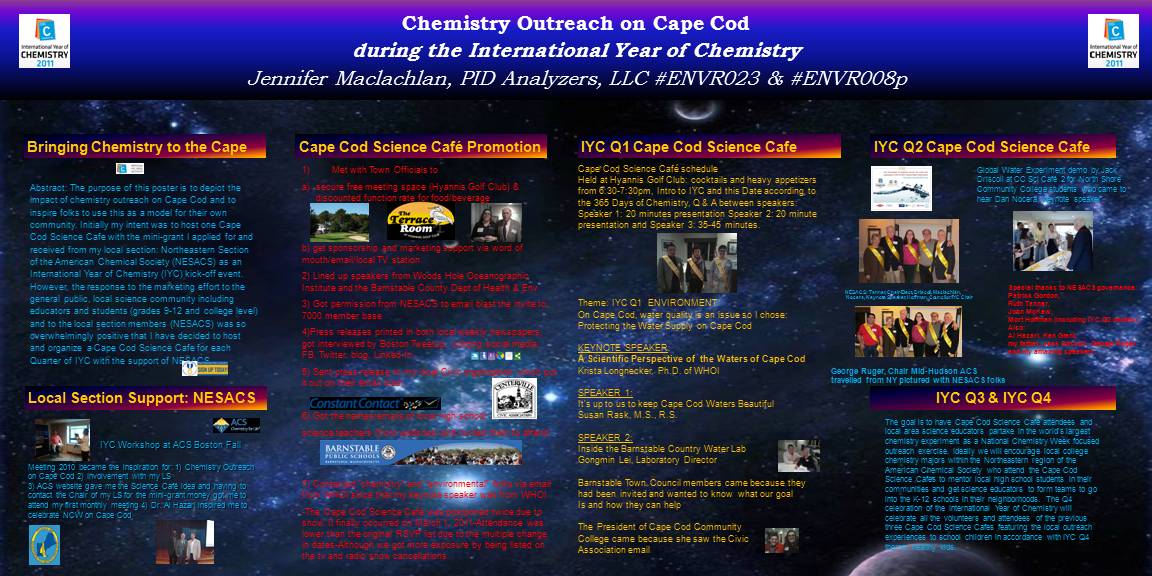
 My colleague will be at my ENVR : Division of Environmental Chemistry poster #ENVR023: Chemistry outreach on Cape Cod during the International Year of Chemistry
Program Area: ENVR: Division of Environmental Chemistry
Symposium Title: (ENVR023) Sci-Mix

Tuesday morning 8/30/11  and Wednesday morning 8/31/11 9am-12pm-See me on the EXPO Floor-Stop by the SCHB booth #1730-I'll be there from 10am-1pm. Come and learn about the SCHB: whose objective is to aid in the formation, development, and growth of small chemical businesses.
Here is the SCHB Fall newsletter including Denver program overview and specific SCHB symposia. 


Tuesday afternoon 8/30/11 Presidential Symposia & awards:  Communicating Chemistry to the Public symposium moderated by ACS President-Elect Bassam Shakhashiri (co-sponsored by ACS President Nancy B. Jackson and the ACS Committee on Public Relations and Communications) on Tuesday afternoon from 1:00 p.m. to 4:30 p.m. at the Colorado Convention Center, Room 108. Speakers include journalists from print, web, radio and television; a chemist-cookbook author; science toys expert; and the author of the 2012 National Science Board’s Science Indicators public opinion chapter.RSVP using the Schmap.

and James T. Grady-James H. Stack Awards Reception/SE-21/$10 4:30 to 6 PM, Colorado Convention Center RM 605

Tuesday evening 8/30/11. The fun begins at 8pm.

Posters, ChemLuminary Awards and Dancing Chemists...come and celebrate the International Year of Chemistry at the Fall National Meeting. 8pm Sheraton Denver Downtown. 
An official IYC event.
RSVP using the Schmap
 

NESACS Celebrates #IYC2011 at the Q2 Cape Cod Science Cafe
Wednesday evening 8/31/11 ENVR: Division of Environmental Chemistry General Poster Session #ENVR008p: Chemistry outreach on Cape Cod during the International Year of Chemistry 
Document ID: 10095
Program Area: ENVR: Division of Environmental Chemistry
Symposium Title: (ENVR008p) General Posters


Looking forward to seeing you in Denver!


Monday, August 15, 2011

Advantages of a Hyphenated PID/MS Combination for GC Applications #pittcon 2012

Advantages of a Hyphenated PID/MS Combination for GC Applications 
Status: 
Accepted for POSTER Presentation Pittcon 2012:    ACS Analytical Chemistry Divison 
Slot #24 03/12/12

Methodology: Gas Chromatography/Mass Spectrometry

Keywords:  
Flavor/Essential Oil
Forensic Chemistry
Gas Chromatography/Mass Spectrometry
Hydrocarbons


Authors & Affiliations:
Jack Driscoll, PID Analyzers, LLC
Clifford M. Taylor, Shimadzu Scientific
Jennifer Maclachlan, PID Analyzers, LLC


Abstract:
There are many situations where a second detector can save time and effort, even for a mass selective detector (MSD).  These include critical analyses (forensic samples) where duplicate analyses are needed, where small samples or low concentration samples are being analyzed, where flavors or odorous compounds are being analyzed or if a high level sample is being analyzed.

The photoionization detector (PID) is a very sensitive, non destructive detector for VOC’s (low or sub ppb), with a wide dynamic range (>5 x 10⁷. When arson samples are analyzed, one serious problem is a “no detect”. When a sample is not detected, one is required to run additional samples to confirm those results since it could be either a bad injection or bad sample. If a second sensitive detector is run at the same time and a small peak is observed then only one additional sample has to be run.   In addition, the data generated in arson analysis must be legally defensible - this creates the need for duplicate sample analysis (or dual detector analysis) as well as sample archival.

The PID is non destructive so the effluent, a flavor component, can be sniffed as the peak is being detected. This allows olfactometry to be coupled with the specific identification of a peak. No splitter is required. Elimination of the splitter is an advantage since a small difference in flow could cause an error in identification of the peak. The PID is very sensitive for aromatic hydrocarbons. The detection limit of the PID is 0.5 ppb of benzene so low levels of sample can be detected and “no detects” should be minimized. The PID is not easily contaminated by high levels of sample. If the MSD is run downstream of the PID, and a low dead volume valve is in front of the MSD, then a high level sample could be switched to minimize contamination of the MSD.

We will evaluate these applications and others to determine the feasibility of using a second detector in combination with the MSD.

Thursday, August 11, 2011

Recent Discussion from the AIHA Linked-In Group about the use of a PID


Jennifer Maclachlan

  Updated as of 8/15/11 by Posted by PID Girl: Jennifer Maclachlan

Wednesday, June 15, 2011

PID Analyzer Field Portable PID Logging Software

PID Analyzer Field Portable PID Logging Software

Monday, June 6, 2011

The 4th Generation Photoionization Detector

Model_52_PID 511

Monday, May 23, 2011

#AIHCE 2011 Wrap-Up-the word from Booth 718


We heard it from an industrial hygienist
                                                                     in Portland, OR


Chlorinated hydrocarbons are a hot topic right now for first responders from fire departments and government agencies such as Homeland Security and Transportation Security Administration.We have been specializing in the measurement of chlorinated hydrocarbons since our development of the 11.7 eV long lifetime photoionization detector lamp in 1979. This lamp is available for the hand-held PIDs and for our portable gas chromatographs. Click here for more information about use of a photoionization based analyzer for the measurement of chlorinated hydrocarbons.


Web site
We brought along the first ever sold HNU PI-101 to Portland because we were showcasing it at The Chemistry of Industrial Hygiene Instrumentation Reception during the conference and we brought it to the booth thinking folks would get a kick out of it. We elicited a huge response from attendees most of whom were unaware that they could still get service from us on their old (and beloved) 101 series photoionizers.   Check out our "A New Era in Photoionization" brochure here.


Real-Time Detection Systems: our fast gas chromatograph Model 322 was extremely popular in Portland, OR. Although we introduced the Far-Ultraviolet detector in 1984, it remains underutilized. The most attractive feature of the FUV is that it is nearly universal and is more sensitive than the Thermal Conductivity Detector (TCD). Jack Driscoll and Phil Smith presented research at AIHCE for an industrial hygiene application using the fast GC Model 322 which uses resistively heated columns in the oven and a dual detection method: photoionization detector and a far-UV detector. Click here for more info on this application.


As a member of the American Industrial Hygiene Association's Real-Time Detection System Committee (AIHA RTDSC), Jack Driscoll is co-authoring a book with Phil Smith, Past Chair of the AIHA RTDSC called "Important Instrumentation and Methods for the Detection of Chemicals in the Field". Jack has contracted to contribute the last section of the book on the subject of Infrared Analyzers. He recently completed the Photoionization and Specialized Detectors sections.

Updated May 27, 2014


Far UV Absorbance Detector-The FUVAD

The Far UV Absorbance Detector

"Theory-Most organic and inorganic species absorb strongly in the far UV (FUV). Notable exceptions are the inert gases, helium and nitrogen which absorb very weakly in this region. Certain
diatomic species such as O which have low absorption in the region of the lamp energy 2 (124 nm) will have a poor response but low ppm levels can still be detected.

The far UV detector is relatively new to gas chromatography (compared to other  GC detectors) since it was introduced by HNU Systems in 1984. It is frequently compared with the thermal conductivity detector since it will respond to any compound that absorbs in the far or vacuum UV. The latter name is a misnomer since with a carrier gas flowing through the cell, a vacuum is not needed. Thus, the detector has a response that is nearly universal, a low dead volume (40 µl), and a fast electrometer time constant.
The primary emission from this lamp is the 124 mn line. Although there are visible lines from this lamp, the photodiode is unresponsive to any long wavelength UV or visible emissions and only the absorption at 124 nm needs to be considered for the absorption
process.

The minimum detection limits for organic compounds, oxygen, water, and
inorganic compounds are in the range from 0.1 to 10 ppm. A summary of the detection limits for organic and inorganic compounds is given in Table I.

Table I
Detection Limits for the FUV Detector


Compound Detection Limit (ng)
Sulfur dioxide 0.7
Methane 0.3
Oxygen 14
Water 3
Propane 1
Chloroform 5
Ethylene 1
Hydrogen sulfide 3

The HNU Far UV Detector (FUV) utilizes a simple, compact detector consisting
of a stable UV source, absorption cavity (1 cm path), and novel UV photodiode. The  detector has a universal response to all species which absorb in the 120 nm region. See Figure _ below. No response is observed for for noble gases or nitrogen. Thus, helium or nitrogen make ideal carrier gases. The
detector responds in accordance with the Lambert Beer Law:

I = Io e-kx

where I = Measured intensity

Io = Incident intensity

k = absorption coefficient

x= path length

Photons emitted from the far UV lamp (Io)are absorbed by molecules passing
through the cell causing a net decrease in photon flux to the photodiode (I). The changes in photon flux exhibits the Lambert Beers law relationship with concentration. The photodiode responds to the decrease in lamp flux and the change is amplified and
recorded.

The linearity of this detector is better than 104. The sensitivity of this detector is similar to the FID for methane and 25-100 times better than a TCD for selected compounds. In addition, the FUV detector is nondestructive and can be run in series with other detectors.
Applications include trace levels of 02, H20 and inorganic gases which have been difficult to detect at sub-microgram levels previously.

Features

Universal Response-
Responds to organic and inorganic compounds that absorb at 120 nm with detection limits 100 times lower than TCD
Sensitivity Subnanogram
for most compounds
Suitability for Capillary Column Analysis
Low dead volume (<50µL) allows operation with minimum make-up
Non Destructive-Allows series operation of detectors
Simplicity of Response
Unidirectional peaks, Beers Law Relationship  
Adaptability-
Is readily adaptable to ANY chromatograph  
Ease of Operation-
no additional gases needed
Linearity->104
The detection limits for a number of compounds are given below in Table:
Applications

Trace water in helium, nitrogen, semi conductor gases, or process streams
Detector with nearly universal response & detection limits in the low or sub ppm levels
Responds to all hydrocarbons with equivalent or better sensitivity for Methane (CH4) than the FID
Ideal complement to the PID"
Source of quoted text: Copyright 1998-2011 PID Analyzers, LLC 

For more information on this subject check out a chapter that Jack Driscoll wrote titled: FarUV ionization (Photoionization) and Absorbance Detectors.

Wielding social media for effective science communication

  ABSTRACT SYMPOSIUM NAME: Combatting Science Mis- and Dis-Information ABSTRACT SYMPOSIUM PROGRAM AREA NAME:  CINF CONTROL ID:  3910009 PRES...