 Accepted for presentation at #acsBoston on the American Chemical Society Division of Environmental Chemistry August 16-20 2015 at both SCI-MIX and ENVR posters ABSTRACT SYMPOSIUM NAME: SCI-MIX and General Posters |
| ABSTRACT SYMPOSIUM PROGRAM AREA NAME: [ENVR] Division of Environmental Chemistry |
| CONTROL ID: 2253367 |
| PRESENTATION TYPE: Poster |
 |
| AUTHORS (FIRST NAME, LAST NAME): John N. Driscoll1, Jennifer L. Maclachlan1 |
| INSTITUTIONS (ALL): 1. PID Analyzers, LLC, Sandwich, MA, United States. |
.png) ABSTRACT BODY: ABSTRACT BODY: Abstract: We reported recently that the photoionization detector (PID) with a 10.6 eV lamp responds to mercury (Hg) with detection limits of 10 ppb. The PID is a non-specific method for Hg since it also has a strong response to VOC’s. Other non-specific methods like UV absorbance and atomic fluorescence use a gold pre concentrator (GPC) to collect Hg by forming a Au/Hg amalgam at room temperature, purging to remove water and VOC’s then rapidly heating to 500oC to release the Hg. We have found that this same technique can be coupled to the PID to produce an analyzer with detection limits in the ppt range. For Hg in water, the hydride method can be used to reduce Hg+2 to form elemental mercury that is concentrated on a GPC and detected by PID. This method has low ppt detection limits. This presentation will describe the method and results in detail. |
Showing posts with label #ENVR. Show all posts
Showing posts with label #ENVR. Show all posts
Saturday, May 16, 2015
A new technique for ppt levels of mercury in air & water


Tuesday, August 12, 2014
2014 ChemLuminary Award Finalist Posters

 2014 ChemLuminary Award Finalist Poster Session Reception was Tuesday August 12, 2014 from 8:00 - 9:00 PM and the awards were announced beginning at 9:00 PM, Palace Hotel, San Francisco.
The Northeastern Local Section was a finalist in five event categories and received three, one of which I organized together with the Division of Environmental Chemistry!
 |
| L to R: Tracy Williamson, Chair ACS DIvision of Environmental Chemistry, Tom Barton, ACS President 2014, and Jennifer Maclachlan, ACS Division of Environmental Chemistry Appropriations Committee Member and Northeastern Local Section Public Relations & Communications Team Member |

 |
| I am the Public Relations Chair for the ACS Division of Small Chemical Businesses and I prepared this poster by working with members of the Georgia Local Section who organized this collaborative event with SCHB at the recent SERMACS regional meeting. |
 |
| I serve on my Local Section PR Committee so I volunteered to compile and create this poster. I also organized several of the events so that made it easy to do. Read about the NESACS Outstanding Continuing Public Relations Program here |
 |
| I am on the ACS Division of Environmental Chemistry Executive Committee (Appropriations Committee) and this event that is nominated for two 2014 ChemLuminary Awards is one that I planned. So naturally I volunteered to create this poster. Read about the Outstanding National Chemistry Week event for a specific audience here |
Thursday, May 8, 2014
#ACSsanfran with @pidgirl and @pidguy
 |
| Jennifer Maclachlan (@pidgirl) and Jack Driscoll (@pidguy) Cape Cod April 2014 |
Jack and I have a hearty technical program planned at #ACSsanfran in August 2014. We will be presenting work in five technical divisions of the American Chemical Society including: ANYL, SCHB, AGFD, ENVR, and ENFL. We look forward to seeing you at the meeting.
Learn more about the meeting here.
Sunday Morning August 10, 2014
 Abstract Body: The EPA has recently reduced the action level for lead in drinking water from 25 ppb to 15 ppb. Since Pb+4 forms a stable hydride that has an ionization potential of >10 eV, it can be detected using a photoionization detector (PID) with a lamp energy of 10.6 eV. We have shown previously (1) that hydride generation PID can be used to detect arsenic in well water at sub ppb levels. We have modified that method by using H2O2 to oxidize any Pb+2 to Pb+4. We are now able to detect total Pb in water down to 1 ppb. The hydride generation minimizes any sample preparation, the new PID improves the detection limit by 3-10 fold, and the GC is used to separate the PbH4from other metal hydrides and their organic counterparts.
Driscoll, JN et, al, “Detection of As in VT Well Water by HG/GC/PID", ACS Meeting in NOLA, April 2013

 SCHB at SCI-MIX Monday August 11, 2014 8pm
Abstract Body: In our thirty-fourth year, our mission remains the same: to aid in the formation, development and growth of small chemical businesses. We do this by continuously providing relevant programming and social events at ACS national and regional meetings for attendees who currently own and operate their own small chemical businesses as well as for those who are considering it. In 2012, SCHB began entrepreneurial programming with the Southeastern Pennsylvania (SEPACS), Northeastern (NESACS), and Georgia Local Sections. In 2013, with the assistance of an ACS IPG, SCHB arranged programming at other scientific society meetings, including AAAS, APS, and CLEO. In 2014, in collaboration with PROF, we hosted networking lunches for our speakers, member, and other interested persons. In 2015, SCHB will sponsor several symposia at Pacifichem. At this 2014 San Francisco meeting, SCHB invites you to attend our technical sessions, meet old friends and new connections at our reception, visit our expo booth and "discuss businesses," and join us for lunch. After the meeting, stay in touch with SCHB member via Linked-In, Facebook, Twitter and on the ACS Network.
Sunday Morning August 10, 2014
ACS DIVISION OF ANALYTICAL CHEMISTRY
ANYL ORAL SESSION: Advances in Separation Full Day Session
ANYL ORAL SESSION: Advances in Separation Full Day Session
Title: New technique for the detection of ppb levels of lead in drinking water by HG/GC/PID
Presenting author: Jack Driscoll
Abstract Body: The EPA has recently reduced the action level for lead in drinking water from 25 ppb to 15 ppb. Since Pb+4 forms a stable hydride that has an ionization potential of >10 eV, it can be detected using a photoionization detector (PID) with a lamp energy of 10.6 eV. We have shown previously (1) that hydride generation PID can be used to detect arsenic in well water at sub ppb levels. We have modified that method by using H2O2 to oxidize any Pb+2 to Pb+4. We are now able to detect total Pb in water down to 1 ppb. The hydride generation minimizes any sample preparation, the new PID improves the detection limit by 3-10 fold, and the GC is used to separate the PbH4from other metal hydrides and their organic counterparts.Driscoll, JN et, al, “Detection of As in VT Well Water by HG/GC/PID", ACS Meeting in NOLA, April 2013
SCHB at SCI-MIX Monday August 11, 2014 8pm
Title: ACS Entrepreneurial Resource Center Showcase East: Guide to a successful entrepreneurial event
Presenting author: Jennifer Maclachlan
Abstract Body: The mission of the ACS Entrepreneurial Resource Center is "to advance chemical entrepreneurs and provide resources to members with a practical business plan and/or start-ups." The Showcase East Organizing Committee asked me to join and help organize this event. My expertise was augmented by the resources of and support from the ACS Division of Small Chemical Businesses (SCHB), Northeastern Local Section (NESACS), and Committee on Public Relations and Communications (CPRC). This poster illustrates the success of the ACS Entrepreneurial Resource Center Showcase East event, which occurred April 9, 2014 in Waltham, MA and emphasizes the importance of a truly collaborative team with clear and consistent channels of communication, goals, and distribution of tasks. The ACS Entrepreneurial Resource Center Showcase West event will take place on August 14, 2014, at the ACS 248th national meeting in San Francisco.
SCHB at SCI-MIX Monday August 11, 2014 8pm
Title: SCHB offers networking opportunities and benefits for small chemical businessesAbstract Body: In our thirty-fourth year, our mission remains the same: to aid in the formation, development and growth of small chemical businesses. We do this by continuously providing relevant programming and social events at ACS national and regional meetings for attendees who currently own and operate their own small chemical businesses as well as for those who are considering it. In 2012, SCHB began entrepreneurial programming with the Southeastern Pennsylvania (SEPACS), Northeastern (NESACS), and Georgia Local Sections. In 2013, with the assistance of an ACS IPG, SCHB arranged programming at other scientific society meetings, including AAAS, APS, and CLEO. In 2014, in collaboration with PROF, we hosted networking lunches for our speakers, member, and other interested persons. In 2015, SCHB will sponsor several symposia at Pacifichem. At this 2014 San Francisco meeting, SCHB invites you to attend our technical sessions, meet old friends and new connections at our reception, visit our expo booth and "discuss businesses," and join us for lunch. After the meeting, stay in touch with SCHB member via Linked-In, Facebook, Twitter and on the ACS Network.
TUESDAY MORNING AUGUST 12, 2014 10:20am-10:50am
ACS DIVISION OF AGRICULTURAL AND FOOD CHEMISTRY GENERAL ORAL SESSION AGFD
Title: New analytical method for low level detection of arsenic in food and beverages
Presenting author: Jack Driscoll
 Abstract Body: Since As+3 and As+5 form stable hydrides that have ionization potentials of 10.5 eV, it can be detected using a photoionization detector that has a lamp energy of 10.6 eV. Photoionization has been coupled to hydride generation and shown to be a very sensitive technique by a number of researchers to determine arsenic in natural waters at low or sub ppb concentrations. The disadvantage of this technique is that it uses a liquid nitrogen trap to concentrate the arsine.
We have modified that method by eliminating the liquid nitrogen and using a new PID that improves the detection limit by up to 10 fold. We can detect arsenic down to 0.1 ppb. We have applied this method to the analysis of water, juices and rice.
The hydride generation minimizes any sample preparation, and the GC is used to separate arsenic from other metal hydrides and their organic counterparts.
TUESDAY Afternoon August 12, 2014
ACS DIVISION OF ENVIRONMENTAL CHEMISTRY
SESSION: Evolving Science and Environmental Impacts of
Hydraulic Fracturing
D. Drogos, Organizer; T. Barton, Organizer; D. Drogos, Presiding Papers 377-384
ENVR-Presidential Symposia
 Title: Environmental and process measurements in fracking operations with a portable gas chromatograph
Presenting author: Jack Driscoll
Abstract Body: The use of horizontal drilling and hydraulic fracking of shale has catapulted the US into one of the leading producers of natural gas in 2012. The producers are interested in the natural gas composition (C1 to C6 hydrocarbon and BTU content). Local Environmental Agencies will be concerned with leakage of methane from the fracking operation both from a reduction in the O2 level where employees work or a large leakage of a potential greenhouse gas during production. Another application involves the investigation of contamination of methane in local water supplies or streams. Data will be presented utilizing the PID Analyzers Model 312 portable gas chromatograph (GC) configured with a flame ionization detector (FID) that will detect hydrocarbons from ppm to percent levels. A dual column system is used for the various fracking applications described above. The portable GC has an embedded PC with PeakWorksTM software for GC control and peak integration. The internal battery and the pressurized cylinder will allow the GC to operate for 8-10 hours. This flexible and sensitive field portable GC is ideal for monitoring environmental concerns associated with fracking operations.
Tuesday afternoon August 12, 2014 1:30pm
ENFL Session Advances in analytical methods for petroleum upstream applications*
*We were invited to give this talk

Presenting author: Jennifer Maclachlan
Abstract Body: There are occupational and environmental health and safety issues related to petroleum upstream applications such as those associated with hydraulic fracking including chemical exposure of workers during hydraulic fracturing operations as well as the wastewater, methane leaks from fractures in the shale and leaks into the ecosystem including but not limited to groundwater, marshes, drinking water. In this paper, we will illustrate how our analyzers can achieve the following applications: methane in air, methane leaks from the shale, methane in water using a static headspace method, hydrocarbon contaminants in the hydraulically pumped water, arsenic in the water since this is a common pollutant in shale and the 20th most common element in the earth's crust and product analysis: the BTU content of the gas needs to be determined. We will discuss the analytical methods and various in-field instrumentation for monitoring these problems utilizing our portable GC-FID, our low cost hand-held FID which is ideal for leak detection and our R&D100 award winning arsenic in water analyzer. A modification of our portable gas chromatograph configuration results in a technique for measuring the product gases produced by fracking. An analytical method for each of the methane applications as well as the arsenic in water application will be described.
ENVR POSTER SESSION: Wednesday evening August 13, 2014 6pm
California Air Monitoring: From Inception to
Current Trends in the New Millennium
J. Maclachlan, Organizer; J. Driscoll, Organizer; J. Maclachlan, Presiding Papers 586-587
J. Maclachlan, Organizer; J. Driscoll, Organizer; J. Maclachlan, Presiding Papers 586-587
Abstract Body: One of the most serious contamination problems in LA in the early 2000's was leaking from underground gasoline storage tanks. At high levels of VOC's (thousands of ppm), the pump and treat effluent can simply be flared. At about 1,000 ppm, it requires too much auxiliary fuel to burn the effluent. A new collection system such as a carbon bed is required. Continuous monitoring is required to determine when breakthrough of the VOC's occurs. Then, the carbon bed should be changed.
The most popular technique for carbon bed monitoring is photoionization and the instrument includes a programmable setpoint that shuts down the pump allowing the carbon bed to be changed. The application of continuous monitoring instrumentation to soil vapor extraction (SVE) is described as one of the few innovative technologies that has gained wide use for cleaning up contaminated sights.
Monday, January 13, 2014
California Air Monitoring: From inception to current trends in the new millennium at #ACSSF
Hope you can join us for our California Air Monitoring Poster Session
Scheduled for Wednesday evening August 13, 2014 at 6pm
California Air Monitoring: From inception to current trends in the new millennium organized by Jennifer Maclachlan and Jack Driscoll
Sunday, October 27, 2013
National Chemistry Week Comes to Cape Cod
 Blog post updated: September 4, 2014
This one event was a finalist in two separate 2014 ChemLuminary Award categories in San Francisco August 12, 2014: Outstanding Collaboration Between a Local Section and a Division AND Outstanding National Chemistry Week Event for a Specific Audience
Blog post updated: September 4, 2014
This one event was a finalist in two separate 2014 ChemLuminary Award categories in San Francisco August 12, 2014: Outstanding Collaboration Between a Local Section and a Division AND Outstanding National Chemistry Week Event for a Specific Audience
The event described below won the 2014 Chemluminary Award for Outstanding Collaboration Between a Local Section and a Division. Pictured are the members of the Northeastern Local Section of the American Chemical Society and the Environmental Chemistry Division with members of ACS governance, receiving the award on stage at the Palace Hotel in San Francisco, CA on Tuesday August 12, 2014.
Update: September 12, 2014-NESACS offered to let us borrow the award. Jack was delighted to bring it to PID Analyzers today!


 |
| Photo by Peter Cutts Photography |
We'll bring it with us to our meeting at the Cape and Islands Boy Scouts of American Council office next week for our organizing committee meeting for the continuing program: Wicked Cool Science Cafe 2014. Organizing Committee with the Award Photos to follow.
Update: September 18, 2014
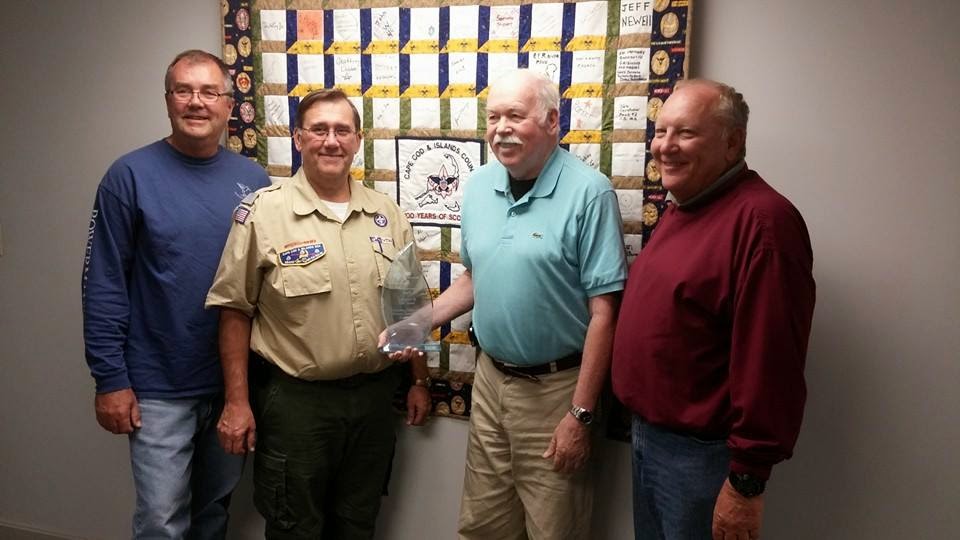
Jack Driscoll presented the ChemLuminary award that NESACS and ENVR won in San Francisco for the joint ACS/Boy Scout event, to some of the members of the 2013 Wicked Cool Event Organizing Committee, who represent the Cape and Islands Council of the Boy Scouts of America.
Update: September 18, 2014
Jack Driscoll presented the ChemLuminary award that NESACS and ENVR won in San Francisco for the joint ACS/Boy Scout event, to some of the members of the 2013 Wicked Cool Event Organizing Committee, who represent the Cape and Islands Council of the Boy Scouts of America.
By: Jack Driscoll, NESACS Public Relations Chair and ENVR Division Member and Jennifer Maclachlan, NESACS Public Relations Committee Member and ENVR Appropriations Committee Member
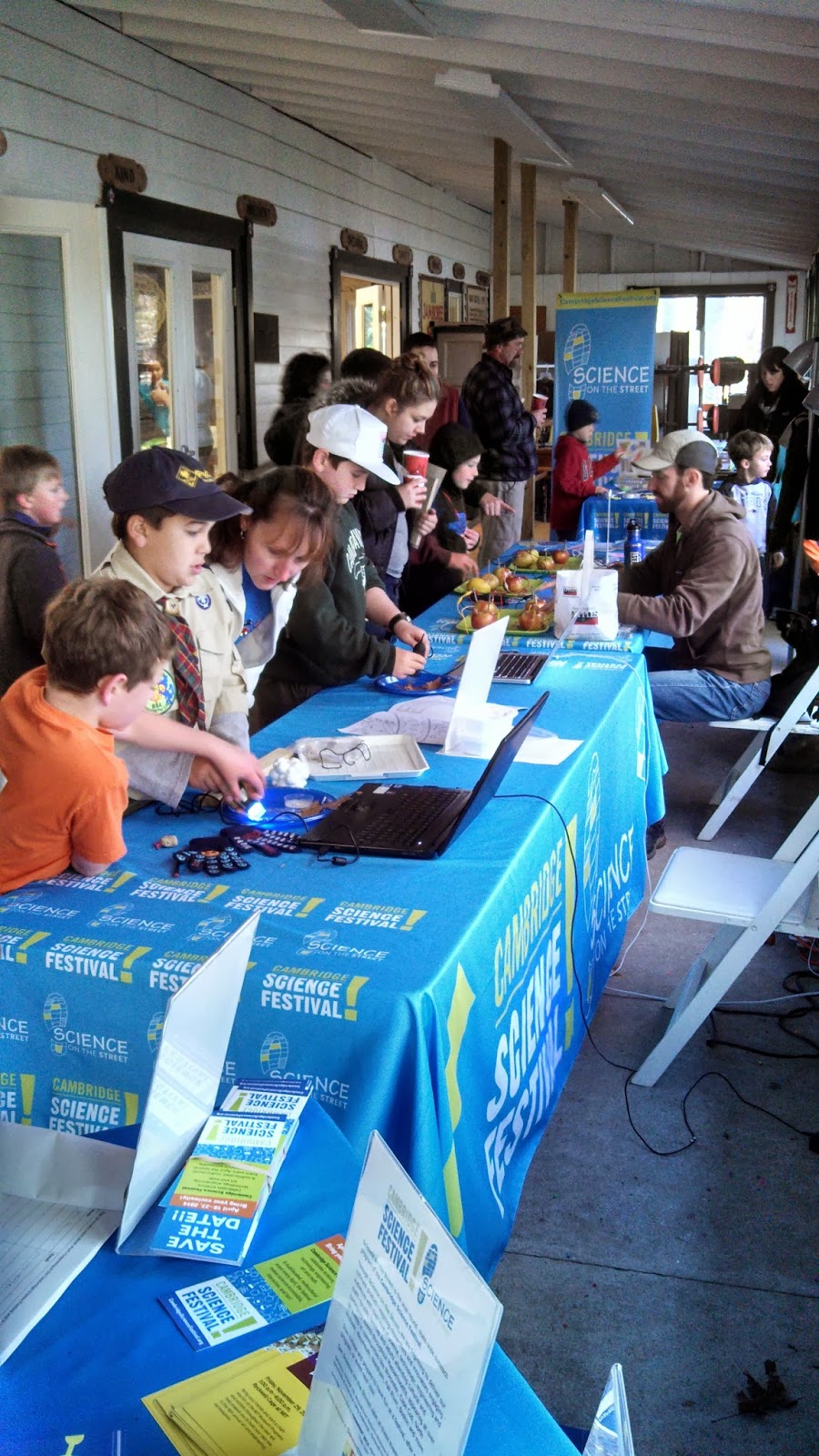 |
| Cambridge Science Festival brought a variety of energy- related experiments to *Wicked Cool* including making batteries using apples |
NESACS and ENVR Bring National Chemistry Week to Cape Cod to Join with the Boy Scouts Wicked Cool Autumn Festival on Oct. 26, 2013
The Northeastern Section of the American
Chemical Society (NESACS) is one of the largest of the 187 sections of the American Chemical Society (ACS) with 7,500 members from academia and industry. We have had 11 Nobel Laureates in our section. The majority of the members (about 80%)are located in Boston. Cape Cod is in the South Eastern part of the section and during the International Year of Chemistry (2011), NESACS worked with PID Analyzers, a Cape Cod analytical and environmental instrumentation company, to run four science cafes for our members and the public. These very successful topics included protecting Cape Cod water, Alternate Energy, Chemistry of Beer (hosted by Cape Cod Beer) and Healthy Kids (for K-6 at Sandwich Public Library). The audiences ranged from 40 at the first Science Café to 150 at Healthy kids (K-6) Cafe. Learn more about the Cape Cod Science Cafe here.
Each year since 1987, the ACS runs National Chemistry Week (NCW) with a theme and each of the 187 sections participate. The theme of this year’s NCW is energy (Oct. 20-26, 2013). NESACS has programs for K-12 students at the Boston Museum of Science and the Boston Children’s Museum. We reach more than 3,000 children during that week with our events.
How we got involved with the Boy Scouts:
Our friend, Dennis Walczewski, whom we recruited to work at the NESACS/SCHB table at the American Association for the Advancement of Science (AAAS) Family Science Days event earlier in the year thought we could do something similar with the Cape and Islands Council of the Boy Scouts where Dennis serves on their board.
A STEM committee was formed to include Boy Scout board members, interested stakeholders and Jack Driscoll and Jennifer Maclachlan. Planning meetings began this summer and it was agreed that we would bring STEM programming into an existing event with a bigger, stand-alone event slated for next year (March 2014). We decided to incorporate a Science Café into the Boy Scouts Wicked Cool Autumn Welcome in October which is held at their campgrounds in South Yarmouth: Camp Greenough. Since this event is during NCW, and our Science Cafes have been quite popular, this was a natural fit with the Boy Scouts Annual Event. We merged the Wicked Cool Autumn Welcome with the Science Cafe and it became the Wicked Cool Science Cafe. The patch seen left was given as a "participant" patch to all the kids who attended the event. Our Local Section partnered with the American Chemical Society Division of Environmental Chemistry for this event.

Below is the event flyer that was used to promote the event to both the Boy Scout families as well as throughout the Cape Cod school district via backpack or virtual backpack. In order to do this, permission must be granted via the Superintendent of Schools for each District.

  |
| We had "Wicked Cool Science Cafe" labelled Glow Sticks at our Chemistry Ambassador table which is where kids picked up their Passports to Chemistry and got their glow stick and patch when they completed the various activities |
 |
| Nancy Gifford, Middle School Science Teacher in Harwich and Jennifer Maclachlan, NESACS/ENVR are both members of the Organizing Committee for the Wicked Cool Science Cafe. |
 |
| Wicked cool patch. We're from Massachusetts- We're allowed to say *wicked* |
How we got involved with the Boy Scouts:
Our friend, Dennis Walczewski, whom we recruited to work at the NESACS/SCHB table at the American Association for the Advancement of Science (AAAS) Family Science Days event earlier in the year thought we could do something similar with the Cape and Islands Council of the Boy Scouts where Dennis serves on their board.
A STEM committee was formed to include Boy Scout board members, interested stakeholders and Jack Driscoll and Jennifer Maclachlan. Planning meetings began this summer and it was agreed that we would bring STEM programming into an existing event with a bigger, stand-alone event slated for next year (March 2014). We decided to incorporate a Science Café into the Boy Scouts Wicked Cool Autumn Welcome in October which is held at their campgrounds in South Yarmouth: Camp Greenough. Since this event is during NCW, and our Science Cafes have been quite popular, this was a natural fit with the Boy Scouts Annual Event. We merged the Wicked Cool Autumn Welcome with the Science Cafe and it became the Wicked Cool Science Cafe. The patch seen left was given as a "participant" patch to all the kids who attended the event. Our Local Section partnered with the American Chemical Society Division of Environmental Chemistry for this event.
 |
| Craig Christensen, Director of the Electrical Engineering Department at Suffolk University, was very popular with his alternative energy items including a Mendocino motor, Wimshurst machine, hand crank generator, wind mill, sparkers, and a mini-hand-crank train set race. |
Below is the event flyer that was used to promote the event to both the Boy Scout families as well as throughout the Cape Cod school district via backpack or virtual backpack. In order to do this, permission must be granted via the Superintendent of Schools for each District.
 |
| Peg from Cambridge Science Festival got to work outside by the lake administering the rocket launching. |
The participants in this event included: ACS, NESACS, ENVR, Cambridge Science Festival-Science on the Street, Suffolk University Physics and Engineering Dept., Liquid Robotics, Green Briar Nature Center, Zephyr Education Foundation marine research and others. There were hands on experiments for K-6 students.

Our chemistry ambassadors above are some of the local area scientists who talked to the kids about their careers. They are from Liquid Robotics, PID Analyzers, LLC , Zephyr Education Foundation and Woods Hole Oceanographic Institute (WHOI). We had envisioned this event being a K-12 event, but it ended up being K-6 which made the planned career talks turn out differently than planned but neat in it's own way-We paired the scientists at the outreach tables and they interacted with the kids and told them cool things about their jobs.
Our chemistry ambassadors above are some of the local area scientists who talked to the kids about their careers. They are from Liquid Robotics, PID Analyzers, LLC , Zephyr Education Foundation and Woods Hole Oceanographic Institute (WHOI). We had envisioned this event being a K-12 event, but it ended up being K-6 which made the planned career talks turn out differently than planned but neat in it's own way-We paired the scientists at the outreach tables and they interacted with the kids and told them cool things about their jobs.
A follow-up Boy Scout’s STEM event on March 29, 2014 in conjunction with the American Chemical Society National Event: Chemists Celebrate Earth Day (CCED) occurred. Due to the success of both of these programs in 2013 and 2014, we will continue to offer an October and March program in 2014/2015. Save the date for National Chemistry Week comes to Cape Cod on Saturday October 25, 2014 and STEM Journey on March 28, 2015.
Thursday, June 27, 2013
Air Monitoring Symposium Monday afternoon at #ACSINDY

Air Monitoring Symposium #ACSIndy

 Sponsored by PID Analyzers, LLC

Cosponsored by AGRO, ANYL, and CHAS

J. Maclachlan, Organizer
J. Driscoll, Presiding

 Oral Session

Monday September 9, 2013
1:30pm-5:25pm
In room service of coffee, cookies & lemonade
Location: Crowne Plaza at Historic Union Station
Room: Penn Station B
1:35 98. Comparison
of Federal Equivalent Method (FEM) and Federal Reference Method (FRM) in
evaluating PM2.5 in Cincinnati, Ohio. K. Li, M. Lu,
1:55 99. Characterization
of particulate matter (PM) generated from commercial DC-8 jet burning
petroleum-based JP-8 and synthetic FJ and HRJ fuels. C. Huang, R.L. Vander Wal,
2:15 100. Impact
of nanostructure on soot oxidation: Pressure and fuel comparisons. C.
K. Gaddam, R. L. Vander Wal,
2:35 101. Dynamics
of airborne PCBs illuminated using a strategic deployment of active and passive
samplers. D. Hu, T. Schulz, C. Persoon, K. Hornbuckle
Department of Civil and Environmental Engineering, IIHR-Hydroscience and Engineering, The University of Iowa, Iowa City, Iowa
Department of Civil and Environmental Engineering, IIHR-Hydroscience and Engineering, The University of Iowa, Iowa City, Iowa
 |
| Air Monitoring IND speakers L to R: P.A.Smith (#ACSNOLA), J.N. Driscoll (#ACSNOLA and Presiding #ACSIndy) and K.K.Brown (#ACSIndy). Photo taken at the 2013 American Industrial Hygiene Conference and Exposition #AIHCE Montreal, Canada Real-Time Detection Systems Track |
3:15 Intermission.
3:30 103.Improved quantitation of sulfur compounds in the atmosphere by hyphenated GC-FPD-PID. J. N. Driscoll, J. L. Maclachlan, PID Analyzers, LLC
3:50 104. Personal
PID chemical sensor coupled with a real-time location system to create a novel
direct-reading exposure assessment method. K. K. Brown,1 K. R. Mead1,
P. B. Shaw1, R. J. Kovein1, R. T. Voorhees2, A. R. Brandes3, .(1) Division of Applied Research and Technology, Chemical Exposure Monitoring Branch, National Institute for Occupational Safety and Health (NIOSH), Cincinnati, OH 45226, United States, (2) Department of Chemistry, University of Cincinnati, Cincinnati, Ohio 45221, United States, (3) MeasureNet Technology, Ltd., Cincinnati, Ohio 45226, United States
4:10 105. Tunable
electronic noses for monitoring volatile small molecules.
K. Benkstein, A. Vergara, C. Montgomery, S. Semancik
K. Benkstein, A. Vergara, C. Montgomery, S. Semancik
4:30 106. Assessing
spatiotemporal commensurability for semi-volatile compounds in passive and
active sampling through simulated passive air sampling rates and
concentrations. S. N. Spak1,2, N. T. Petrich1, C. E. Shanahan2, G. R. Carmichael1,3, D.
Hu1, A. Martinez1, Z. Rodenburg1, K. C. Hornbuckle1 (1) Department of Environmental Engineering, University of Iowa, Iowa City, Iowa 52242, United States, (2) Public Policy Center, University of Iowa, Iowa City, Iowa 52245, United States, (3) Department of Chemical & Biochemical Engineering, University of Iowa, Iowa City, Iowa
4:50 Discussion.
5:20 Concluding
Remarks.

What's ahead: Call for Papers #ACSDallas:

Subscribe to:
Posts (Atom)
Wielding social media for effective science communication
ABSTRACT SYMPOSIUM NAME: Combatting Science Mis- and Dis-Information ABSTRACT SYMPOSIUM PROGRAM AREA NAME: CINF CONTROL ID: 3910009 PRES...

-
 The Northeastern Section of the American Chemical Society celebrated National Chemistry Week 2015 in the Boston area at ...
 -
 Barnstable residents, John Driscoll and Jennifer Maclachlan, a dynamic father-daughter team who own and operate PID Analyzers, LLC are in ...
 -
 This presentation has been accepted for the technical program of the 245th ACS National Meeting that will be held in New Orleans, Louisiana...