Thursday, April 25, 2013

Frederick F. Spaziani Memorial Award 2013


Frederick F. Spaziani Memorial Award 2013

RECOGNITION DAY


The Frederick F. Spaziani Memorial Award 2013 
scholarship is awarded by a Suffolk University faculty committee to one full-time and one part-time student in the Chemistry, Physics and/or Engineering program on the basis of merit. 


2013 awardees are both on the Astrophysics Track: Casey Myers and Elizabeth Rodriguez.  Jack Driscoll will be there to award Casey and Elizabeth tonight, April 25, 2013 at the C. Walsh Theatre.
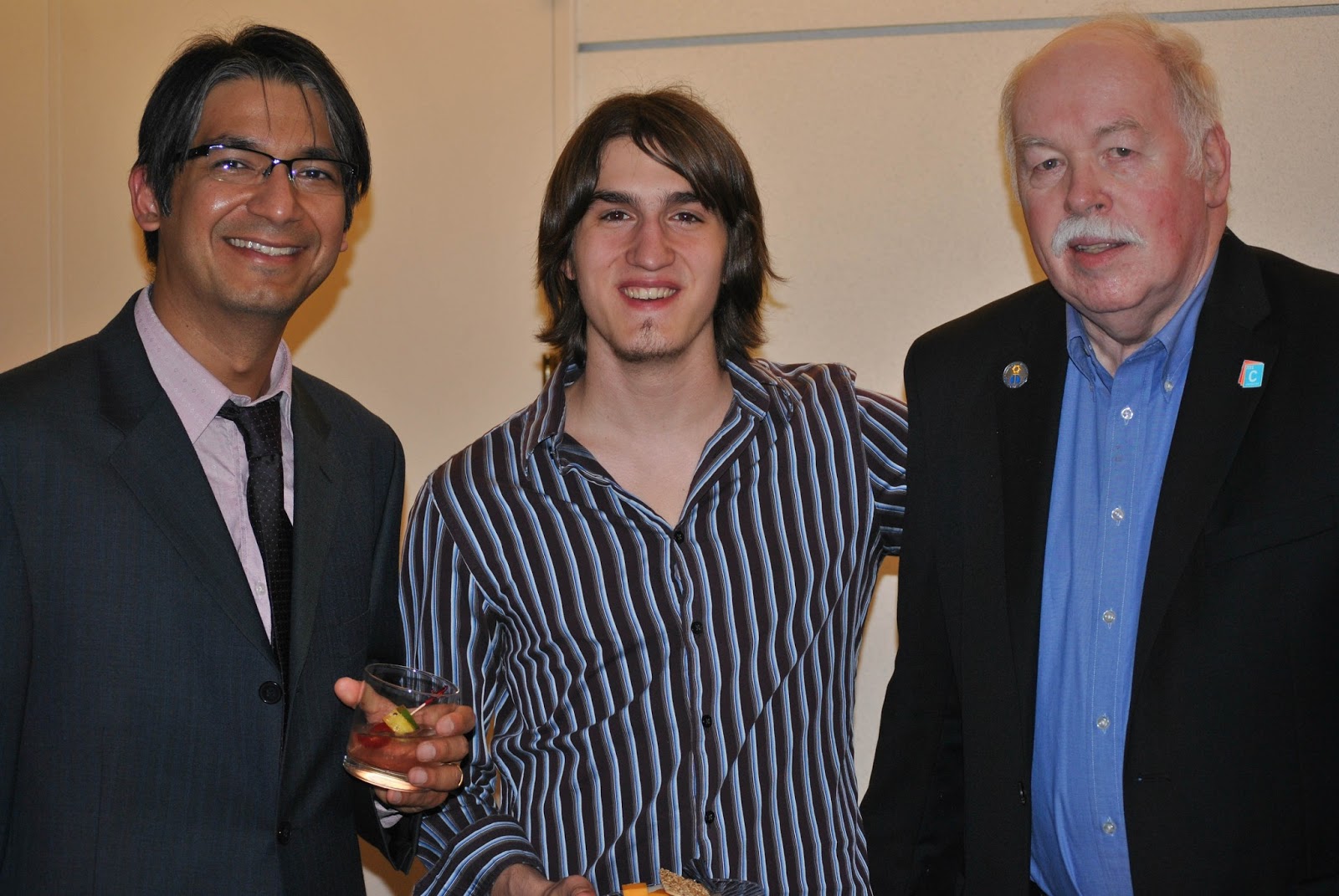


Prashant Sharma, Chair Physics Dept at Suffolk U, Casey Myers, 2013 Spaziani Memorial Award recipient and Jack Driscoll, Spaziani Memorial Award Administrator. 


Both award recipients submitted essays that illustrated their creative use of physics.
Casey employed some culinary physics to save prep time while working as a pizza chef in high school. "Everything we see around us in the natural world can be explained using physics. Physics is my passion because the world is my event, and I will always ask the question why".
This is the second consecutive year that Elizabeth is a Spaziani award recipient. Elizabeth's essay details her experience as a Suffolk University teaching assistant who developed curriculum and led an astrophysics field trip for non-science majors to the Suffolk University Maine Campus Friedman Field Station. In her words: "In the end, most of the students were able to find most of the objects on the list by using all of the equipment and trying to be creative with the telescopes in order to achieve this". 
Congratulations to Casey and Elizabeth! We are honored to present each of you with the 2013 Spaziani Memorial Award. 

Fred Spaziani co-founded of  HNU Systems, Inc. with Jack Driscoll in 1973. Together they developed the first commercial photoionization detector that is now the most important method for measuring volatile organic compounds. Fred left us at too early an age and the award is to help students in science or engineering reach their full potential.

Saturday, April 13, 2013

Climate Science: The Conversation at Cambridge Science Festival Monday April 15, 2013

EVENT WAS POSTPONED DUE TO THE TRAGIC EVENTS THAT OCCURRED AT THE BOSTON MARATHON ON MONDAY AFTERNOON. 


Join us this Marathon Monday evening April 15, 2013 at the NESACS Science Cafe at the Cambridge Science Festival. This is the second consecutive year that NESACS is participating at the festival. Last year National ACS had an NSF grant and we worked with them on The Chemistry of Food Science Cafe. This year we are participating in the Science Communication Day at the festival and together with the festival organizers, decided to explore how to communicate scienceformally and informally using an example like climate science, as the basis for the conversation and a science cafe format as the communication mechanism.

This is our program description: A meteorologist, a journalist, and a climate scientist walk into a bar and...Seriously though, how do we best communicate scienceformally and informally? And how does it all get applied in a specific example like Climate Change?Join in the discussion with our panel of experts: Dave Epstein, Brian Helmuth and Peter Thomson. This panel discussion will be facilitated by Jack Driscoll, NESACS PR Chair.

Event is hosted by: John Harvard's Brew House. 33 Dunster St, Harvard Sq in the back room. Event occurs Monday April 15, 2013 from 7pm-9pm. Cost is free to attend. Cash bar is 21+. Please RVSP using the link below if you plan to attend because seating is limited.
A quick note about each of the panelists: for more information on each of them, use the links to see their bio info. Dave Epstein is a meteorologist who worked in the Boston media (Channel 5) for sixteen years and blogs for The Boston Globe. We were introduced to Brian Helmuth, our Climate Scientist, through Pam Mabrouk, the NESACS Women Chemists Committee Chair. Peter Thomson is with NPR and is the Environment Editor for The World who happens to have a passion for climate science. 

Here is the online flyer is below and here is the RSVP link. We hope you can join us and help us make this a robust and informative conversation about communicating science.

Climate Science: The Conversation~A Science Cafe at Cambridge Science Festival by Jennifer Maclachlan


Wednesday, April 10, 2013

Major symposium on arsenic contamination in food and water supplies at #ACSNOLA

Below is a link to the press release that was issued April 10, 2013 at 9:05am CST. It includes ALL of the speakers, titles and abstracts of their talks.

Major symposium on arsenic contamination in food and water supplies


Below, you can watch the ACS LIVE Press Conference on the Major Symposium on Arsenic Contamination in Food and Water that took place at noon on April 10, 2013 in New Orleans.


Video streaming by Ustream


Wednesday, March 27, 2013

Science on the Street on the Cape or how my six year old and I bonded

I spent Saturday afternoon at the Cape Cod Museum of Natural History participating in the Cambridge Science Festival, Science on the Street STEM outreach event. This was an event I had planned to attend with my family but instead we ended up as exhibitors, representing the American Chemical Society. My eight year old daughter enjoys the VIP experience of working at a science festivals for several reasons: getting there before the public is allowed to enter, as the kid of a volunteer she gets to check out and try all the cool activities before everyone else since the other exhibitors are eager to practice on a real kid before the rush and the best is of course having a place to come and rest between doing fun activities. 

Since both of my girls had planned to assist me at the ACS table, I told each of their teachers about it. The second grade teacher suggested I make a flyer that she would send home with the students in the class plugging the event with a call-out box stating that their classmate would be at the Chemistry Table and we hoped to see them there. As a result of the flyer, my six year old had one classmate attend and my eight year old had two classmates attend. My friend's mother who is a Naturalist and had business at the Museum in the morning stuck around to see us setup since her daughter saw on Facebook that we'd be there. She also noted with a wink that she already knew because she saw it on Twitter. Other friends of ours stopped by because they saw my Facebook posts about it. There was something really special to me and to my girls about seeing so many friends at this event in our community. Oftentimes when we are assisting at Local Section outreach events they are in Boston or Cambridge and have a sort of anonymity to them. 

A retired chemist ACS member appeared at my table. He was delighted to see ACS at the event and wondered if we were down the Cape or had come from Boston? I gave him all my contact information and told him about our NESACS Cape Cod Science Cafe events. I would have liked to have spoken to him longer but I had a table full of pint-sized chemists demanding my attention. 

First they were asked if they wanted to do some chemistry and then if they answered yes were instructed to wear goggles to protect their eyes since we were working with liquids. Then if they didn't know how to use an eyedropper (many didn't since most kids were between ages 3-7) they got to practice with it before squeezing drops onto the pH paper, matching the color change portion of the strip with the pH color number chart and then using a meter to compare the results. I was able to have five kids at a time conduct their experiments at my table with the help of my six year old who cleaned up between experiments, assisted children who needed it (even kids older than herself) and kept restocking the Kids Discover Chemistry Magazines

Of course I was met during the one brief lull with a concerned citizen who was inquiring as to whether or not it was *safe* to expose children to toxic chemicals. She gestured towards my red flask which was full of salt water from Barnstable Harbor. And then to the purple flask full of cabbage juice then to the green one with vinegar, well you get the picture. She wandered away from the table looking relieved. 

Before my six year old went to sleep that night she told me that today's festival was the best one we have ever done. It was her favorite. I told her it was my favorite too. Some serious mother-daughter bonding took place while working the chemistry table together. I'm glad we decided to volunteer instead of just attend. Sometimes it really pays to be a VIP. 


Tuesday, March 26, 2013

Sensitive photoionization (PID) method for the measurement of ppb levels of inorganic arsenic in well water

This research paper is part of the Arsenic Contamination in Food and Water symposium Agricultural & Food Chemistry Poster Session which precedes the two day oral symposium at #ACSNOLA.    


166 - Sensitive photoionization (PID) method for the measurement of ppb
 levels of inorganic arsenic in well water

Jack Driscoll1, Jennifer Maclachlan1Janet B. Foley2,
 Tim B Schroeder2(1) PID Analyzers, LLC, Sandwich, MA 02563, United States, 
(2) Bennington College, Bennington, VT 05210, United States

Bennington College is located in southwestern Vermont, an area that has recorded many
 bedrock wells with arsenic levels near and above the 10 ppb limit. We are interested in 
exploring the geochemical conditions and redox chemistry that contributes to the 
solubilization of As(III), the more toxic form of arsenic. We plan to set up some model 
systems in the lab as well as test conditions with samples of local bedrock. We would have 
chosen the older colorimetric method rather than the AA or ICP-MS because the cost of
 these types of spectrometers is outside our price range. We decided to try the hydride
 generation (HG)-PID method for arsenic in water analysis at ppb levels (1) because it is
 more sensitive and more accurate than the colorimetric method and the system cost is a
 fraction of the $200K spectrometer price. We will compare some of our HG-PID results 
with ICP-MS to confirm the accuracy of these tests.[ol][li]Driscoll, JN and GA Cutter, 
“Total and Speciated Arsenic Compounds in Water by Photoionization and Gas 
Link to product literature

Chromatography/PID”in "Toxic Trace Metal Remobilization & Remediation -
 A Geochemical Body of Work" to be published by the ACS (2012)[/li][/ol]

Tuesday, April 9, 2013 02:00 PM
General Posters (02:00 PM - 04:00 PM)
Location: Morial Convention Center
Room: Hall D

Comparison of sensitive methods for the measurement of inorganic arsenic in apple juice: Photoionization (PID) and ICP-MS


This will be presented in the Analytical Methods subsection of the two day Arsenic Contamination in Food and Water Symposium at the American Chemical Society Spring National Meeting in New Orleans April 10 and April 11, 2013 on the AGFD Track. 
299 - Comparison of sensitive methods for the measurement of inorganic arsenic in apple juice: Photoionization (PID) and ICP-MS

Authors: Jack Driscoll1,  Jennifer Maclachlan1,  (1) PID Analyzers, LLC, Sandwich, MA 02563, United States
Link to product literature

In January of 2012, Consumer Reports found 10% of apple juice samples tested from five brands had total arsenic levels above the drinking water standard of 10 parts per billion. Most of that arsenic was inorganic arsenic, a known carcinogen. American apple juice is made from apple concentrate, a majority of which is imported from China. Inorganic Arsenic has been detected as AsH3following reduction via AA or ICP MS. The cost of these types of spectrometers is in the $60-200K price range. Many labs would have to choose the older colorimetric methods but we have developed and modified the hydride generation-PID method for arsenic in water analysis at ppb levels (1) to work with food and juice. The system cost is a fraction of the $200K spectrometer price. We will describe the modifications of the new method for arsenic in apple juice as well as the comparison results with ICP-MS. (1) Driscoll, JN and GA Cutter, “Total and Speciated Arsenic Compounds in Water by Photoionization and Gas Chromatography/PID”in "Toxic Trace Metal Remobilization & Remediation - A Geochemical Body of Work" to be published by the ACS (2013)                           

Thursday, April 11, 2013 08:35 AM

Arsenic Contamination of Food and Water (08:30 AM - 12:20 PM)
Location: DoubleTree by Hilton New Orleans
Room: Madewood B

See document below for complete listing of presenters at Arsenic Contamination in Food and Water at #ACSNOLA

Tuesday, March 5, 2013

PID Analyzers at #Arablab 2013

Together with our friends at Hillsborough Scientific we will be exhibiting at Arablab 2013 in Dubai 10th-13th March. 
Team Hillsborough at Arablab 2011 Photo courtesy: M/s Hillsborough Group

The PID Analyzer products that will be displayed at Arablab Stand No: 816/916 are: Model 102+ portable hydrocarbon analyzer, customize with up to 3 additional sensors, Model 210 paramagnetic oxygen analyzer and Model114 IR-based analyzer for leak detection, environmental, area, or laboratory monitoring applications.

Here is a recent presentation that we did on our Model 102+, one of the featured portable analyzers which will be on display at Arablab and at the Quadrex Corp booth #1202 at Pittcon 2013 in Philly. 

Wielding social media for effective science communication

  ABSTRACT SYMPOSIUM NAME: Combatting Science Mis- and Dis-Information ABSTRACT SYMPOSIUM PROGRAM AREA NAME:  CINF CONTROL ID:  3910009 PRES...